
Transcript
Announcer:
Welcome to CE on ReachMD. This activity, titled “Calming Overactive Immune Response and Reducing Inflammation with TYK2 Inhibition in Psoriasis” is provided by Total CME.
Prior to beginning the activity, please be sure to review the faculty and commercial support disclosure statements as well as the learning objectives.
Dr. Armstrong:
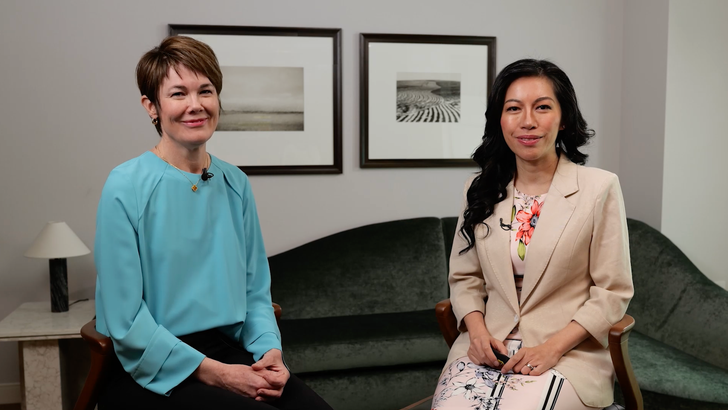
Hi. Are you familiar with the recent data that was shared at the American Academy of Dermatology meeting on TYK2 inhibition in psoriasis? This is CE on ReachMD, and I'm Dr. April Armstrong.
Dr. Gooderham:
And I'm Dr. Melinda Gooderham.
Dr. Armstrong:
So Melinda, over the last decade— I would say actually two decades— there has been tremendous expansion in terms of our options for patients with plaque psoriasis, and especially in the area of moderate to severe plaque psoriasis. In your opinion, what do you think are still some of the remaining challenges or gaps in this particular area?
Dr. Gooderham:
And we've certainly come a long way, I mean, even in our careers, but there's still what we're learning about is that cumulative burden on patients, and there's still a lag or a delay in many patients getting treatment, and that can lead to a cumulative burden over time, whether that's psychological, social. And then at the risk of psoriatic arthritis, there's also a physical burden on the patients, and irreversible damage can be done. So I think one of the key unmet needs is reaching patients earlier to prevent that burden.
When we do get patients on therapy, there is often an issue with adherence. So if you look at, say, even though the biologics have been great for patients, there's no biologic that people stay on 100% of the time. There's always reasons that patients are coming off treatment.
And I think for biologics, some of the reasons are the cold chain requirement, getting things delivered. There are some patients who just don't want injections. There's an injection burden, there's injection site reactions, there are the potential for anti-drug antibodies. So there's a lot of reasons why patients don't stay on a therapy, in particular a biologic.
So having an oral option would be great, ut up to this point, many of the oral options, there's a bit of a trade off with efficacy. So patients may choose to have an oral therapy, but they don't enjoy the same skin clearance that you might have with a biologic. So finding that oral therapy that can provide biologic efficacy, I think, is still an unmet need.
Dr. Armstrong:
Yes, I think those are really critical points about the potential now of our oral therapies to deliver high levels of efficacy but also have very good safety profile. I think that oral options, especially I would say for pediatric, adolescent patient population, I mean, that's a key population where oral therapies, in terms of that mode of delivery, that administration, could be very palatable— pun or no pun intended— for that particular population.
Dr. Gooderham:
Absolutely. Great. So April, and what I'd like to ask you is like, what excites you about these new TYK2 inhibitors that are being explored?
Dr. Armstrong:
Yes, I think there are a number of very exciting aspects about these new TYK2 inhibitors. And we have two TYK2 inhibitors whose phase 3 trial results were unveiled at the American Academy of Dermatology meeting this year, and we have zasocitinib and also envudeucitinib. What excites me about these two is that when we're looking at this new generation of TYK2 inhibitors, we are really working on not only turning up the volume on the potency of the medication, but we are becoming even more selective with regards to targeting TYK2. So we are now looking at medications that are able to really zero in on the JH2 domain of the TYK2, such that pretty much we can leave the other types of kinases alone.
And what that means is that we can actually probably push up on the dosing for these medications and being able to deliver a highly potent medication that works effectively, but also because of the selectivity, that the safety profile of these medications are quite good.
So for example, we learned at this meeting from you actually, Melinda, that for zasocitinib, what we see is that by week 24, we see over 3/4 of the patients, for example, achieving clear or almost clear, or sPGA 0 or 1. And this is very exciting. And you don't have to wait for week 24 to get there. In fact, a lot of the responses we see are much, much earlier. So we see much faster onset of response compared to our older now TYK2 inhibitor, and then also able to reach this deep level of efficacy.
We also see, for example, with envudeucitinib, what we saw around 24 weeks, we see also nearly 70% of the patients achieving clear or almost clear.
And I think very excitingly, both medications also show a good proportion of patients able to achieve that complete clearance. So if we use PASI 100 as a very stringent measure of complete clearance, what we see is that about 40% of the patients in both studies with both newer generation of TYK2 inhibitors are able to achieve that.
And I will say, finally, I want to talk a little bit about safety for these medications. In the clinical trials, it did not show any perturbations in the laboratory abnormalities.
Dr. Armstrong:
And then when we think about safety of these two TYK2 inhibitors, we also notice very reassuring safety profile as well. I think because they're more specific, what we're seeing is not only no elevations or perturbations in terms of different laboratory parameters, but also when we're looking at different rates of adverse events of special interest, we also saw it very similar to that of placebo. So I think they're going to be quite well tolerated, and therefore really , I will say, this really new elevated option in terms of TYK2 for our patients.
Your thoughts?
Dr. Gooderham:
Yeah, I found it was really how similar, in the same ballpark, which I feel really speaks to that mechanism of action, that more highly selective, potent TYK2 inhibition can provide that high level of skin clearance.
Of course, I mean differences between the two. The envudeucitinib was twice daily, whereas the zasocitinib was once daily, although they did announce they're working on a once-daily formulation. But to have that higher dose, as you mentioned, because we were able to take the highest dose from the phase 2, because we saw the safety, and take that highest dose into the phase 3. So it was really great to see the confirmation of the results from what we saw in phase 2, which I believe you were the one that presented a few years ago, and to see the same results in the phase 3 be reproduced.
Dr. Armstrong:
Yes, absolutely. That consistency of results is very reassuring for this particular mechanism.
Now Melinda, if you were to kind of think about the clinical implications of all this, how will this really impact our practice potentially in the future? And all of our dermatologists and dermatology clinicians, how should they interpret this data and then bring that and thinking about the possibility of using them in the future?
Dr. Gooderham:
Yeah, it's a good point because, because of that trade-off in the past with oral therapies not providing the same level of efficacy as a biologic, I think there's going to be a lot of education needed with that, because there's this sort of stigma with oral medications that we have. So just getting the word out that there are, if approved, going to be oral therapies that can provide biologic efficacy, so we won't have that trade-off anymore.
At the same time, as you mentioned about the safety, because there were no clinically meaningful changes in the laboratory parameters, we won't have to have things like ongoing monitoring of the therapies, which makes it more simple for the patient, right? There'll be the baseline workup, and then going on more simple course with just a once-daily pill for the efficacy results.
And as you mentioned as well earlier about the speed of onset, so for example, with zasocitinib, at week 4, 17% of patients achieved a 75% reduction in their PASI, so PASI 75 compared to only 4% of the placebo patients. So you had that really rapid onset in the first 4 weeks. And I think that will help with adherence for patients. When they start to see that benefit early on, they're more willing to go on. So they'll have that rapid response, they'll have a durable response.
We saw that with the randomized withdrawal that patients weren't flaring right away.
Dr. Armstrong:
Yes.
Dr. Gooderham:
Fifty percent of patients maintained their PASI 90 for 20 weeks off of therapy. So I always say that life happens and patients miss doses or have to go off therapy for different reasons— surgery, travel, whatever— and to know that they're going to be able to maintain that benefit, I think, is another bonus for patients.
So it’s an exciting time, right, now that we'll have orals and biologics hopefully on equal footing.
Dr. Armstrong:
Absolutely. And if I can just expand on that withdrawal data, I also thought that was very, very exciting, because when we're thinking about our oral therapies and thinking about our patients in the future potentially missing a dose or two— for example, life happens, and then you get busy and you forget to take your pill— and looking at that data, it really shows that even when that happens, we are reasonably confident that the patient is able to maintain their level of response and efficacy.
Dr. Gooderham:
Which I just think is important, because for JAK inhibitors as a class, especially in atopic dermatitis, if you do miss a few doses, you can flare. So it's that difference in thinking with a different disease state. So psoriasis will behave different than atopic dermatitis, and I think that just will require some education of prescribers and patients.
Dr. Armstrong:
Yes, absolutely.
Well, Melinda, this has been a fantastic conversation. It's always enjoyable talking with you. Now, if you can have just one take-home point for audience members, what would that be?
Dr. Gooderham:
I think getting back to the very first thing I mentioned about the cumulative life impairment and treating patients earlier. I still believe we need to educate about how important it is to treat patients early on in their journey of psoriasis, and I believe an oral therapy like zasocitinib, with high efficacy and good safety, gives more options to patients and will get patients on treatment earlier and help prevent that burden of the psoriatic disease.
Dr. Armstrong:
Yes, yeah, absolutely. I would definitely agree with that. And if I may add, I think when I think about sort of one of the take-home moments is that when we think about our psoriasis treatment evolution, right, we had lots of developments in biologics on one end. We also had a lot of great development in nonsteroidal topical therapies for psoriasis on the other end. And then we had a very good TYK2 inhibitor predecessor, right, sort of more first-generation TYK2 inhibitor in psoriasis that kind of paved the way, I would say, for us as a field to realize the potential of this pathway. But now between biologics and nonsteroidal topicals, the gap here— what I see— is closing with our newer generation TYK2 inhibitors that are much more selective and also able to be more potent in order to deliver the level of efficacy that we haven't seen before with this class of medications.
So it's very exciting.
Dr. Gooderham:
It's very exciting times.
Dr. Armstrong:
Yes, well, I guess time flies when we're having fun. I want to thank you so much for your time with us today, and I also want to thank our audience members for your attention.
Announcer:
You have been listening to CE on ReachMD. This activity is provided by Total CME.
To receive your free CE credit, or to download this activity, go to ReachMD.com/CME. Thank you for listening.
 In support of improving patient care, Global Learning Collaborative is jointly accredited by the Accreditation Council for Continuing Medical Education (ACCME), the Accreditation Council for Pharmacy Education (ACPE), and the American Nurses Credentialing Center (ANCC) to provide continuing education for the healthcare team.
  Global Learning Collaborative designates this activity for 0.25 contact hour(s)/0.025 CEUs of pharmacy contact hour(s).
  Global Learning Collaborative has been authorized by the American Academy of PAs (AAPA) to award AAPA Category 1 CME credit(s) for activities planned in accordance with AAPA CME Criteria. This activity is designated for 0.25 AAPA Category 1 CME credit(s). Approval is valid until 04/30/27. PAs should claim only the credit commensurate with the extent of their participation in the activity.


